Black Walnuts & Phragmites
-
March 05, 2026
-
1183 words
-
7 minutes
Black Walnut: Long Island's Native Ally in the Fight Against Phragmites
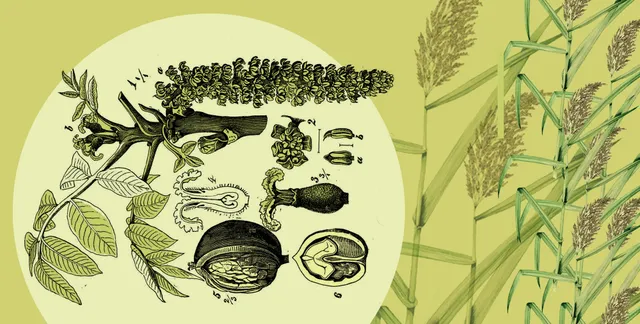
Along the North Shore of Long Island, the black walnut (Juglans nigra) has deep roots — both literally and ecologically. A species native to central and eastern North America, black walnut has long been part of the coastal woodland landscape, thriving in the well-drained, loamy soils characteristic of Long Island's upland edges and stream corridors. Long Island Natives recognizes it as one of the most valuable native nut trees of North America. But beyond its ecological heritage, emerging research is drawing attention to one of the tree's most remarkable and potentially useful traits: its natural allelopathic chemistry. Long Island Natives
A Native with Chemical Muscle
Black walnut produces a chemical called juglone, which occurs naturally in all parts of the tree, especially in the buds, nut hulls, and roots, with leaves and stems containing smaller quantities that leach into the soil after they fall. This chemical inhibits the germination and growth of many competing plant species — a phenomenon known as allelopathy. Juglone works by damaging the tiny root hairs responsible for taking up the majority of water and nutrients, and research also shows it interferes with mycorrhizal fungi that aid nutrient uptake. The Morton ArboretumThe Garden Professors™
Juglone suppresses competing plant growth via a mode of action unlike any commercial herbicide, and researchers at institutions including Purdue University have been actively working to harness it as a novel natural product-based bioherbicide. NIFA
A Potential Weapon Against Phragmites
Non-native Phragmites australis, or common reed, is an aggressively invasive grass that can grow up to 20 feet tall in dense groupings and tends to spread rapidly, colonizing disturbed wetlands and outcompeting native vegetation. In New York, Phragmites is ubiquitous, growing in roadside ditches, tidal and non-tidal wetlands, freshwater and brackish marshes, and along river, lake, and pond edges. PRINCETON HYDRONYIS
Research into juglone's herbicidal properties has found it to be a potent inhibitor of weed growth, with studies showing that juglone concentrations decreased shoot elongation and fresh weight in test weed species, with shoot elongation more significantly affected than root growth. Numerous studies have demonstrated juglone's allelopathic effects on vegetables, field crops, ornamental species, and various weed species, opening the door to its consideration as part of an integrated approach to Phragmites management. RNGRResearchGate
The Nissequogue River: A Local Case in Point
The mouth of the Nissequogue River at Nissequogue State Park offers a compelling local example of both the problem and the potential. The river's tidal estuary and surrounding wetland edges have experienced significant Phragmites encroachment, with dense reed stands pushing into areas that once supported diverse native plant communities. The Seatuck Environmental Association has noted that Phragmites and knotweed can be managed by herbicides, mechanical removal, and hand-pulling — especially when outbreaks are identified early before dense stands take hold — and has demonstrated the potential of volunteer-based hand-pulling at similar North Shore sites. Seatuck
The upland woodland buffers in and around the park — where black walnut trees are part of the native canopy — provide a natural example of how juglone-rich leaf litter and root systems interact with adjacent reed beds at the critical woodland-wetland transition zone. The Nissequogue corridor represents exactly the kind of landscape where an integrated, native plant-based suppression strategy could complement ongoing active management efforts.
A Tool, Not a Cure
It is critical to be clear: black walnut allelopathy is not a silver bullet for Phragmites control, and it should not be framed as one. The highest concentration of juglone occurs in the soil directly under the tree's canopy, and because decaying roots can release juglone, its effects are limited in reach and variable over time. Phragmites is a remarkably resilient species — it invades wetlands by colonizing new areas from seed or rhizome fragments, which can then rapidly expand through clonal growth, and it thrives across wide environmental gradients. On its own, juglone is unlikely to eliminate an established Phragmites stand. The Morton Arboretumnih
What it can realistically do is support and extend the effectiveness of other restoration efforts. Research has shown that native plant recovery following initial Phragmites treatments is highly variable and context-dependent, underscoring the need for multi-layered, long-term management strategies rather than single-method interventions. Strategically placed black walnut trees along upland buffers may help suppress Phragmites recolonization over time — reducing the frequency and intensity of follow-up interventions needed — but only as one layer within a broader, sustained restoration plan. nih
Restoring with What's Already Here
What makes this approach compelling on Long Island is the native status of black walnut. Black walnut is native to central and eastern North America and grows mostly in riparian zones — precisely the woodland-wetland edges where Phragmites pressure is greatest. Unlike introduced biocontrol agents or synthetic herbicides, leveraging juglone works within the ecological framework that already exists here. With careful siting — keeping in mind that juglone can also suppress some desirable native plants — black walnut may prove to be one of Long Island's most valuable and underutilized partners in the slow, patient work of coastal restoration. Wikipedia
References
De Scisciolo, B., Leopold, D.J., & Walton, D.C. (1990). Seasonal patterns of juglone in soil beneath Juglans nigra (black walnut) and influence of J. nigra on understory vegetation. Journal of Chemical Ecology, 16, 1111–1130.
Jose, S., & Gillespie, A.R. (1998). Allelopathy in black walnut (Juglans nigra L.) alley cropping: Spatio-temporal variation in soil juglone in a black walnut–corn alley cropping system. Plant and Soil, 203, 191–197.
Morton Arboretum. (2025). Black walnut toxicity. https://mortonarb.org/plant-and-protect/tree-plant-care/plant-care-resources/black-walnut-toxicity/
New York Invasive Species Information. (2024). Common reed (Phragmites australis). https://nyis.info/species/common-reed/
Seatuck Environmental Association. (2024). Nissequogue River restoration and invasive species management. https://seatuck.org/nissequogue/
Shrestha, A. (2009). Potential of a black walnut (Juglans nigra) extract product (NatureCur®) as a pre- and post-emergence bioherbicide. Journal of Sustainable Agriculture, 33(8).
Topal, S., Guler, S., & Tansı, S. (2007). Herbicidal effects of juglone as an allelochemical. Forest Nursery Notes (Winter 2008). Reforestation, Nurseries and Genetics Resources.
U.S. Department of Agriculture, National Institute of Food and Agriculture. (n.d.). Elucidating the biosynthesis of juglone: A potential natural product-based herbicide.
Willis, R.J. (2000). Juglans spp., juglone and allelopathy. Allelopathy Journal, 7, 1–55.