Dangers of Garlic Mustard
- Melissa Feudi
-
June 12, 2025
-
1538 words
-
9 minutes
HYPOTHESIS:
Garlic mustard is a contributing factor to amphibian loss in the Northeast due to its chemical compound AITC which is volatile compound called Allyl Isothiocyanate.
It has already been proven to have multiple environmental effects on the environment outside it's native range but also within it's native range. According to US EPA, AITC is a biochemical pesticide used as an “insect and animal repellent, feeding suppressant, insecticide, fungicide, herbicide and nematicide” (US EPA, 2013a).
GARLIC MUSTARD:
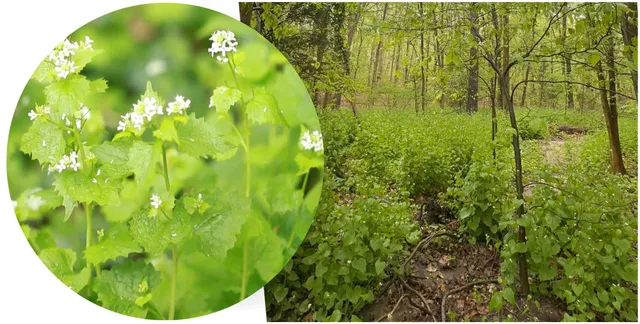
HISTORY: Garlic mustard or Alliaria petiolata, was first introduced into Long Island where it then spread throughout the Northeast. Garlic mustard is an invasive species in North America. It invades by creating monocultures and dominating a forest understory.
CURRENT APPROACH: Garlic mustard is studied to die out if left alone after a few years however thats location specific and it can continue to roll across the landscape through seed dispersal.
WHY TO NOT LEAVE IT ALONE: During it's monoculture invasion it will shade out understories and leave chemicals in the soil for a few years as it breaks down. For an already stressed sick forest (which they most likely are) lot of this chemical may be found in water runoff and be deposited in breeding ponds for frogs and toads.
WHATS GOOD ABOUT IT: It is a tasty plant and can be used to keep pests away. It has many positive attributes to humans for living pest free. Unfortunatey when the pests are out of balance, we get sick ticks that spread disease.
THE EFFECTS OF AITC:
AITC can disrupt all natural functions of a landscape through microscopic interruptions in natural occurring mycorrhiza that effects plant growth and healthy biodiversity.
example:
AITC is used heavily in the sugar industry due to its potent fungicidal activity. In this context, the substance protects sugar beets from fungi during storage (Romanowski, 2000).
AITC is reported to damage DNA and is toxic to aquatic organisms.

AITC EFFECT ON AMPHIBIANS:
Allyl isothiocyanate causes significant adverse effects on mortality, malformation and growth of frog (xenopus laevis) embryos.

Jacksonville State University Biology Department has studied this. They created this compelling study of an African frog where AITC was found to have teratogenic properties and caused frog malformation and mortality.
Effect of allyl isothiocyanate on developmental toxicity in exposed Xenopus laevis embryos
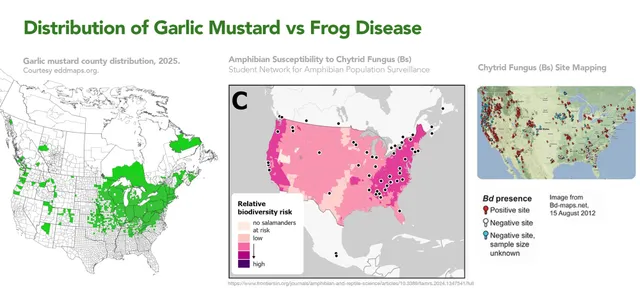
It is my hypothesis that chytrid fungus is able to grow and spread due to the loss of natural fungus and bacteria in the environment caused by the anti-fungal properties of garlic mustard.
Chytridiomycosis, caused by the fungus Batrachochytrium dendrobatidis (Bd).
Amphibian deformities have now been reported in over 30 states, as well as Canada.
Amphibian Research and Monitoring Initiative (ARMI) estimates a 3.7 percent average annual decline in the proportion of sites occupied by amphibians within ARMI study areas (Adams et al. 2013). This rate of decline means that the average amphibian species will be gone from half of the places where it now occurs in < 20 years (Grant et al. 2016).
AITC EFFECT ON TICK DISEASE:
Tick Disease and populations Increases due to Garlic Mustard
- Some benefits like the antibacterial effect of garlic mustard that our landscape hasn't evolved with can be slow killers. Antibacterial compounds kill susceptible bacteria, but some bacteria may have natural resistance or develop mutations that allow them to survive. These resistant bacteria are then free to multiply and become the dominant strains in the population. Lymes is a bacterial disease. It may be more present or aggressive in areas with GM.
- AITC increases tick disease due to its antifungal properties:
AITC EFFECT ON FUNGAL RELATIONSHIPS:
Effects on healthy soil
Garlic Mustard disrupts plant-mycorrhizae symbioses. Many species rely on those fungal relationships to survive.
Fighting Natural Plant / Fungi Relationships
In one paper the title is "A novel impact of a Novel Weapon: Allelochemicals of Garlic Mustard disrupts the Legume-Rhizobia mutualism" the use of the word weapon is apt. The study focuses on the American hog-peanut and how AITC can impact growth and the plants natural relationship to fungi.
———
GARLIC MUSTARD ADDITIONAL THREATS:
Garlic Mustard has also been found to threaten the Virgina White butterfly
ENVIRONMENTAL SOLUTIONS:
BIOCHAR:
Biochar can not kill off the garlic mustard but it can reduce the chemical buildup of AITC.
Biochar can amend soil by soaking up compounds. It asks the question - does traditional controlled burning a possible solution to our garlic mustard problem?